




Indian River Pebble vs Indonesian (Bali) Pebble Mosaic: An Honest Comparison
Almost all of the pebble mosaic on the world market leaves from two places. India ships river pebble. Indonesia ships volcanic pebble, sold nearly everywhere under the trade name Bali pebble. In a catalogue thumbnail they look like close cousins. On a frozen terrace in February, under a UV lamp, or on a landed-cost sheet, they are not.
We are pebble mosaic exporters from India, so read this as an interested opinion — and a checkable one. Measured on the things that decide whether an installation survives its first decade, and on the things that decide whether the order makes money, Indian river pebble comes out ahead more often than the market’s habits suggest. Indonesia’s reputation rests on one product line, and this guide is specific about where that line stops. Everything below is written for people who have to defend the choice to somebody else: a buyer to a board, a distributor to a landscape contractor, an architect to a client holding a sample in their hand.
Where Each Pebble Mosaic Comes From
Indian river pebble
Indian pebble is alluvial. It is gathered from riverbeds, dry channels and old river terraces across Punjab and Karnataka — fragments of quartzite, limestone and granite carried down from the highlands and worn smooth over long distances in fresh water.
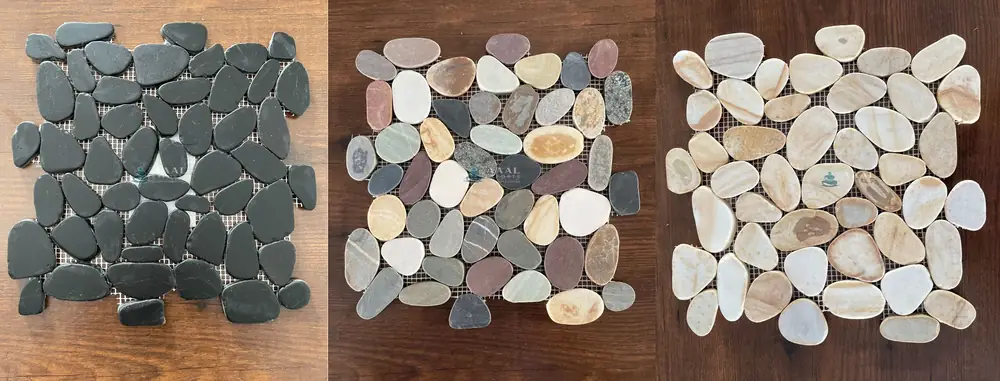
Because the parent rock changes every few kilometres, so does the colour. A single washing yard will grade buff, tan, ochre, rust, olive-grey and near-black out of the same intake. That range is the material’s commercial argument. It means an Indian yard can sort to a single tone for a calm, even field, or blend deliberately for a riverbed look — from the same intake. Breadth of colour is what makes both possible.
Long freshwater transport also tends to produce a flatter, more oval stone. Flat matters more than it sounds. A flatter pebble sits lower on the mesh, takes grout more predictably, walks more comfortably underfoot, and covers more square metres per tonne of container weight.
Indonesian (Bali) pebble
Indonesian pebble is volcanic. Most of it is basalt or andesite collected from rivers and beaches on Java, Sulawesi, Lombok and Bali, then graded, washed and exported through a stone trade that has been organised around Bali for decades. The island gave the material its trade name; a good share of the stone never came from the island itself.
Short, steep rivers and marine tumbling round the stone more thoroughly than a long inland river does. Indonesian pebbles are typically rounder, closer to a true ovoid, more consistent in size, and more repeatable from sheet to sheet.
The colour range is narrower and cooler: black, charcoal, grey, white, cream, and the mixed blends sold as tiger or rainbow. Polished jet black is the origin’s signature product and the reason many specifications name Bali by habit — but it is one line, and outside it the palette runs out quickly.
Indian vs Indonesian Pebble Mosaic: Side by Side
Typical trade ranges, not a specification. Confirm every line against your supplier’s own test data and sample boards.
| Attribute | Indian river pebble | Indonesian (Bali) pebble |
|---|---|---|
| Parent rock | Quartzite, limestone, granite — alluvial | Basalt, andesite — volcanic |
| How it was worn | Long freshwater river transport | Short steep rivers and marine tumbling |
| Typical shape | Flatter, oval to elongated | Rounder, close to a uniform ovoid |
| Sheet consistency | Calibrated or varied — graded to your specification | Uniform only — little choice in the other direction |
| Colour range | Wide and warm: buff, tan, ochre, rust, grey, white, black | Narrow and cool: black, charcoal, grey, white, cream, mixed |
| Colour source | Natural and unenhanced | Polished blacks are frequently enhanced or coated |
| Surface | Matt to satin natural skin | Matt |
| Density and absorption | Denser, low absorption — the harder stone | Varies by grade; the porous end absorbs and spalls |
| Climate fit | Handles freeze-thaw; suits every climate | Warm, humid climates only |
| Formats | Loose, mesh, flat and sliced, standing, borders, custom blends — the widest range | Loose, mesh, sliced, standing — concentrated in a few lines |
| Sheet standard | 300 × 300 mm mesh, about 11.1 sheets per m² | 300 × 300 mm mesh, about 11.1 sheets per m² |
| Loading ports | Mundra, Kandla, Nhava Sheva, Pipavav, Chennai, Tuticorin | Surabaya, Semarang, Jakarta |
Uniformity, Shape and Size: What You Can Actually Specify
Indian yards grade to whatever band you specify. Ask for a tight size window and single-colour sorting and you get a calibrated, even sheet with consistent spacing, sheet after sheet, container after container. Ask instead for a mixed river blend and you get visible geology. The same supply base delivers both, which is the point: with Indian pebble the level of uniformity is something you specify, not something you inherit.
Indonesian pebble arrives naturally rounder, so a uniform sheet takes less sorting to reach. That is a processing convenience, and it comes attached to a narrow palette — black, charcoal, grey, white, cream. If your client wants an even, calm field in a warm tone, in a buff or a soft grey-brown, in a matched border or a step tread, that request runs out of material quickly in Indonesia and does not in India.
So specify the sheet, not the country. State the size band in millimetres, the colour sort, whether you want calibrated thickness, and how much variation you will accept — then approve a physical sheet against it. An Indian yard will hit a tight specification and still give you options on colour and format that the alternative cannot. Approving a sample from one origin and ordering against the other is where this goes wrong, and it is avoidable.
Sizing convention is shared. Pebbles are graded roughly 40–50 mm, 50–60 mm and 60–70 mm, and mounted face-up on 300 × 300 mm mesh, about 11.1 sheets to the square metre. Interlocking edges let sheets knit together so the joint disappears; allow 5–10% wastage for cutting, edge trimming and blending on any pebble tile order.
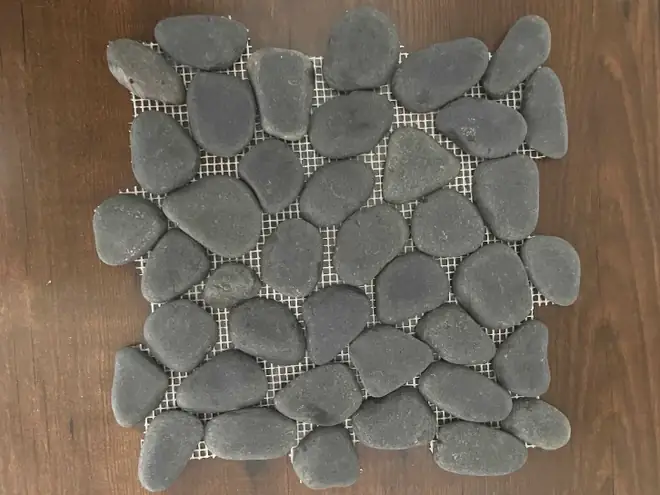
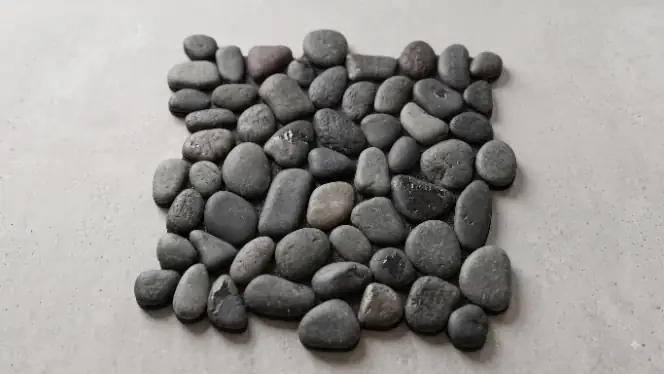
Durability, Porosity and Wet Areas in Pebble Tiles
Quartzite-rich Indian river pebble is the denser and harder of the two, with low water absorption. That is why it holds up on terraces, paths and driveways in climates that freeze: water that cannot get into the stone cannot expand inside it.
Volcanic pebble varies more by grade. Vesicular material — the more porous end of the volcanic range — drinks water, and in a climate with forty freezing nights a year that shows up as spalling and loose stones far sooner than anyone budgeted for. In a heated pool surround in Dubai or Singapore the same material may last indefinitely, which is a fair summary of Indonesian pebble generally: excellent inside its climate band, and exposed outside it. Indian pebble has no climate band.
For slip resistance, pebble is naturally strong — the profile breaks the water film and gives the foot something to key against. If barefoot comfort matters more than texture, specify flat or sliced pebble rather than full round pebble.
Pebble Tile Formats Each Origin Can Actually Make
Both countries supply loose pebble, mesh-mounted pebble mosaic, sliced pebble and standing pebble, and both have established pebble exporters serving the same importers. Capacity behind those lines is what differs.
India’s advantage is breadth and mixed loading. The same factory base that ships sandstone, slate, quartzite and granite also runs pebble lines, which makes it straightforward to order flat and sliced pebble tile, standing pebble set on edge for a ribbed surface, pebble borders and step treads, matched loose pebble held back for repairs, custom colour blends to a client’s board, and several of those in one container. For a distributor testing a new range without committing a full container to each line, that flexibility is worth real money.
Indonesia’s capacity is concentrated rather than broad. Polished black, white and cream, in volume and repeatable — done well, and done for a long time. Ask for a custom blend, a matched border, a step tread or a mixed load, and you are usually back to India.
Installing and Maintaining Pebble Mosaic
Pebble mosaic fails on site far more often than it fails as a material. These are the points worth passing to whoever lays it, and they apply equally to both origins. For a full step-by-step walkthrough, see our guide on how to install pebble mosaic tiles.
- Full bed, no voids. Every pebble needs mortar contact. Voids under a round stone are where water collects, freezes and lifts. Use a flexible polymer-modified adhesive and back-butter where the sheet profile is uneven.
- Seal before grouting. On polished, light or porous pebble, an unsealed stone takes grout haze into its surface and never fully releases it. Seal, grout, clean, then seal again once dry.
- Decide the grout height first. Grout to roughly two-thirds of the pebble for the classic relief look, or fuller for wet areas and easier cleaning. Agree it on a mock-up panel, not on the job.
- Break the joints. Rotate and stagger sheets, and hand-place a few loose pebbles across the seams. A visible 300 mm grid is the giveaway of a rushed installation.
- Clean with pH-neutral products only. Acidic cleaners strip sealer, etch any marble-based pebble and dull polished blacks. Re-seal on a cycle set by exposure — annually for open terraces, less often indoors.
Sourcing, QC and Export Logistics from India
The material comparison decides what you want. The supplier comparison decides what you get. Run the same eight checks on any pebble mosaic tile exporter in India, Indonesia or anywhere else — the questions below separate a trading desk from an actual processor.
- Wet and dry sample boards. Full 300 × 300 mm sheets, not loose stones in a bag. Photograph them wet before you approve.
- Natural or enhanced, in writing. Put the answer on the proforma invoice. It converts a conversation into a claim you can hold someone to.
- Mesh and adhesive spec. Nylon or fibreglass mesh with non-yellowing adhesive, bonded across the full sheet. Cheap mesh sheds pebbles in transit.
- Thickness tolerance. Ask whether sheets are calibrated and to what tolerance. Uncalibrated sheets cost the installer hours in bedding.
- Batch blending. Confirm that sheets are drawn and mixed across batches before packing, and that crates are marked with the batch.
- Packing and moisture. Fumigated wooden crates on pallets, sheets dry before packing, breakage allowance agreed in advance.
- Pre-shipment inspection. Third-party or video inspection against the approved board, before the container is sealed rather than after.
- Documentation. Invoice, packing list, bill of lading, certificate of origin and any phytosanitary certificate for the packing timber, issued without chasing.
Two logistics figures are worth knowing before you negotiate. A 20 ft container takes roughly 900 to 1,100 m² of 300 × 300 mm mesh-mounted pebble mosaic, depending on grade and thickness — thicker, rounder stones weigh out before they cube out. And freight per square metre is a real line on the costing, not a rounding error, which is why a flatter pebble that gives more square metres per tonne can be cheaper delivered even at the same FOB price. Compare landed cost per square metre. It is the only number that decides anything.
On transit: India loads through six ports — Mundra, Kandla, Nhava Sheva, Pipavav, Chennai and Tuticorin — with strong sailing frequency to Europe, the Middle East, Africa and both American coasts, which covers most of the world’s pebble demand. Indonesia’s three ports hold the advantage into Australia, New Zealand and East Asia. Geography, not salesmanship, decides this, and the geography favours India for the larger share of buyers.
Where Indian Pebble Mosaic Is the Better Buy
Four places where the gap is not close.
- Warm, natural earth tones. Buff, tan, ochre, rust and mixed river blends are India’s native palette, and they are the stone’s own colour rather than an enhancement. For garden, courtyard and landscape work, nothing else reads the same.
- Cold climates and freeze-thaw exposure. Quartzite-rich, dense and low in absorption. On an exposed terrace in northern Europe or the northern United States, that density is the whole ballgame.
- Range, custom work and mixed containers. Flat and sliced pebble, standing pebble, borders, custom blends to a client’s board, and other natural stone in the same load. Distributors building a range rather than reordering one line get further here.
- Landed cost into Europe, the Gulf, Africa and the Americas. Lower FOB, more square metres per tonne, and shorter sailings to most of those markets. Three advantages that compound on the same costing sheet.
Notes for Architects and Specifiers
If you are writing pebble mosaic into a specification rather than buying it, six lines will prevent most of the disputes that follow.
- Name the origin, not just the look — Indian river pebble mosaic and Indonesian pebble mosaic are different materials, and specifying Bali by habit rules out the denser, unenhanced option before anyone has priced it.
- State the pebble grade in millimetres and the sheet size, and require interlocking edges.
- Require a statement of natural or enhanced colour, and reject enhanced material for external work unless it is warranted.
- Set a maximum water absorption figure appropriate to the exposure.
- Require a mock-up panel of at least one square metre, laid, grouted and sealed, approved wet and dry before bulk delivery.
- Specify blending across batches and a retained quantity of loose matched pebble for future repairs.
Pebble Mosaic FAQs
Is Indian river pebble mosaic cheaper than Bali pebble mosaic?
FOB, Indian pebble mosaic is usually the lower of the two, and a flatter Indian pebble covers more square metres per tonne, which lowers freight per square metre as well. Only short-haul buyers in Australia, New Zealand and East Asia narrow that gap, and rarely enough to overturn both the lower FOB and the better coverage per tonne. Compare landed cost per square metre, not FOB per square metre.
Does black pebble mosaic fade outdoors?
Naturally dark stone holds its colour. Colour-enhanced or coated black pebble — most common in the polished Indonesian lines — can drift towards grey under UV and rain, sometimes within two or three seasons. Ask any supplier, in either country, whether the colour is natural or enhanced, get the answer in writing, and weather a sample board before you commit to a container.
Can pebble mosaic be used in a swimming pool?
Yes — in pool surrounds, steps, water features and shower floors — provided the stone is dense, fully bedded with no voids, and sealed with a penetrating sealer before and after grouting. Ask for a water-absorption figure rather than a promise; at or below about 0.5% is comfortable for wet and submerged work.
What size are pebble mosaic sheets, and how many cover a square metre?
The trade standard from both origins is a 300 × 300 mm mesh-mounted sheet, about 11.1 sheets per square metre before wastage. Pebbles are usually graded 40–50 mm, 50–60 mm and 60–70 mm. Allow 5–10% wastage for cutting, edge trimming and blending.
How much pebble mosaic fits in a 20 ft container?
As a planning figure, roughly 900 to 1,100 m² of 300 × 300 mm mesh-mounted pebble mosaic, depending on grade and thickness. Thicker grades and rounder, fatter stones weigh out before they cube out, so confirm the exact loading against the specific grade you are buying.
Which Indian ports ship pebble mosaic?
Most Indian pebble mosaic moves through Mundra, Kandla, Nhava Sheva (JNPT), Pipavav, Chennai and Tuticorin, which gives good sailing options into Europe, the Middle East, Africa and both coasts of North America.
Is Indian pebble suitable for freeze-thaw climates?
Quartzite-rich Indian river pebble is generally dense and low in absorption, which is why it performs well on terraces and paths in cold climates. Ask for water-absorption and frost-resistance data for the specific grade rather than relying on origin alone.
Can I order a mixed container of pebble mosaic and other stone?
Yes. India’s broad stone-export base makes mixed loading straightforward — pebble mosaic, sliced and standing pebble, loose pebble for repairs, and slate, sandstone or quartzite in the same container. It is a practical way for distributors to test several lines without committing a full container to each. Write to inquiry@aaalexports.com for a quote.
The Short Version
Indian river pebble mosaic is the stronger default: the denser stone, the natural unenhanced colour, the wider palette and format range, and the better landed cost into Europe, the Gulf, Africa and the Americas. Indonesia earns the order in one case — a polished jet-black field, shipped short-haul into Australasia. Outside that, the specification is asking for what India already does better.
The rest is supplier diligence, and that part is identical either way: wet and dry boards, a written answer on colour, a mock-up panel, and an inspection before the container is sealed.
Pebble mosaic tile exporters — India
Send us the sample the client approved. We will match it in Indian river pebble mosaic, and show you where ours is the better stone.
AAAL Exports is among the established pebble mosaic tile exporters in India, supplying pebble mosaic, pebble tiles, sliced pebble tile, standing pebble and loose river pebble to importers, distributors and contractors worldwide. Wet and dry sample boards, mixed containers, pre-shipment inspection.
Email – inquiry@aaalexports.com
Phone – +91 9810443277
Web – www.aaalexports.com